Articles
Practical guides and technical deep-dives for security professionals and system engineers.
Anvil v2.2.30: Many Hands, One Anvil
Anvil v2.2.30: Many Hands, One Anvil Anvil has always been the AI that runs where you work and answers to you — your models, your...
Anvil v2.2.29: Manage Your Anvil
Anvil has always been the AI that runs where you work and answers to you — your models, your keys, your data, your machine. With...
Anvil v2.2.25: The Security Hardening Release
Anvil v2.2.25 is a security-only release: fifteen findings from a deep, adversarially-verified audit, all fixed. Relay pairing, Windows credential ACLs, sandbox isolation, and MCP transport hardening. No criticals, no config migration, recommended for all.
Anvil v2.2.24 — Stable Sessions, Grok Refresh, and a Sandbox You Control
Anvil v2.2.24 is a stability and reach release. It fixes a daemon crash that could drop a session the instant you connected, corrects text selection...
Anvil v2.2.23: Talk to It, Reach Further, See What It's Doing
Anvil v2.2.23: Talk to It, Reach Further, See What It's Doing Anvil v2.2.23 is the voice & reach release. You can now dictate to Anvil...

Anvil v2.2.21 — Durable Daemon Sessions, the Relay Bridge, and the Big Modularization
v2.2.21 is the largest single-release reshape Anvil has had since v2.0. Session execution moves out of the TUI and into the anvild daemon — close...

Anvil v2.2.20 — The Five-Feature Arc: Signed Provenance, Anti-Skills, Event Routines, A/B Curator, Memory Federation
v2.2.20 is the five-feature arc. The self-improvement foundation we laid in earlier work grows up: every skill now carries a signed ed25519 lineage ledger, the...
Anvil v2.2.19 — 18 Languages, Memory Cohesion Complete, the Web-Based MCP Builder
Anvil v2.2.19 is the i18n + Memory Cohesion arc. Two long-running commitments close in this release: Anvil now ships in 18 languages with a wizard...
Anvil v2.2.18: Fix the Compaction Bug, Restore Copy-Paste, Finish the Web Viewer
Anvil v2.2.18: Fix the Compaction Bug, Restore Copy-Paste, Finish the Web Viewer Three bugs. One release. Anvil v2.2.18 lands today with fixes that have been...
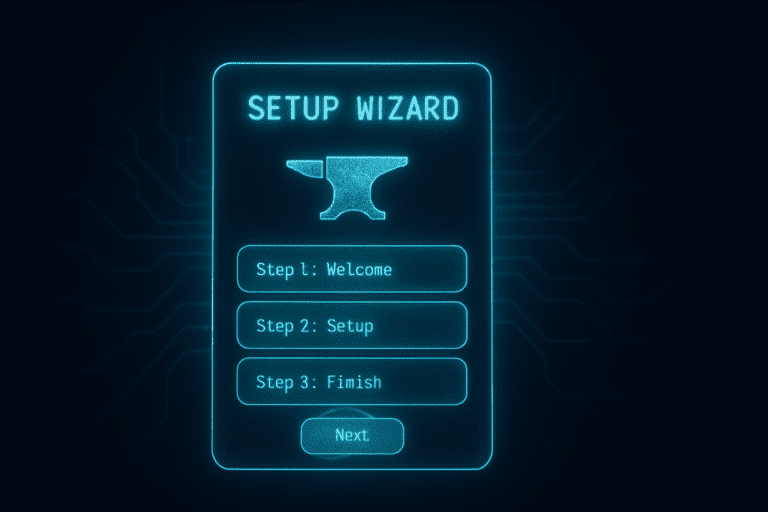
Anvil v2.2.17 — The Setup Wizard, Reflection, Sandboxing, and the Source Viewer
Anvil v2.2.17 is live across seven platforms today. This release rewrites the first-run experience as a single in-TUI alt-screen wizard, adds an autonomous reflection loop...

Anvil v2.2.16 — The TUI Layout System
Anvil v2.2.16 ships today with the TUI Layout System. Eight live-switchable layout variants built on a per-tab TuiLayoutConfig. The terminal UI is no longer a...

Anvil v2.2.15: 31 Providers, One Binary, Zero Lock-In
The largest release in Anvil's history is here. v2.2.15 ships today with a 6x expansion of the provider catalog, a first-class command tree for Cursor's...

Building Secure Plugin Systems: Preventing Command Injection and Path Traversal in Extensible CLI Tools
Why Plugin Security Matters Extensible CLI tools are everywhere. VS Code loads extensions. Terraform dynamically provisions providers. Package managers execute install hooks. The moment you...

Zero Warnings: A Practical Guide to Cleaning Up a 10,000-Line Rust Codebase
Why Zero Warnings Matters Compiler warnings are not suggestions. They are the compiler telling you, with high confidence, that something in your code is wrong,...

Terminal-to-Browser: Building a Live Bidirectional Remote Control with WebSocket Relays
The Goal Let a user type /remote-control in a terminal app and immediately hand their session to any browser — phone, tablet, laptop — with...

AI Coding Tools in 2026: Anvil vs Claude Code vs Codex vs Cursor — An Honest Comparison
Disclaimer We built Anvil. That means this comparison comes with an inherent conflict of interest. We've done our best to write an honest assessment —...

Anvil v2.2.4: The AI Coding Assistant That Gives You Live Remote Control
The Problem with Every Other AI Coding Tool Every popular AI coding assistant shares the same architectural assumption: you are sitting in front of the...

Kubernetes Network Policies: Microsegmentation and East-West Traffic Control
Implement zero-trust microsegmentation in Kubernetes using Network Policies with default deny, service-to-service rules, and egress control.

Incident Response Automation: Building Playbooks with Workflow Orchestration
Build automated incident response playbooks for brute force, malware, and credential leak scenarios using workflow orchestration tools.

GlusterFS for High-Availability Storage: Replication, Self-Healing, and Production Deployment
Deploy a production GlusterFS cluster with 3-way replication, automatic self-healing, and performance tuning for distributed storage.

Email Security Architecture: SPF, DKIM, DMARC, and MTA-STS Implementation
Complete guide to implementing email authentication with SPF, DKIM, DMARC, and MTA-STS for production mail infrastructure.

Dark Web Monitoring Techniques for Security Teams
Practical techniques for building dark web monitoring capabilities including credential leak detection, threat actor tracking, and IOC extraction for SOC integration.
Anvil v2.1.0 — Encrypted Vault, File Sandbox, Modular Architecture
Security-First Architecture Anvil v2.1.0 is our most security-focused release yet. Every credential you trust to Anvil is now protected by military-grade encryption, and agents are...
Prompt Injection Defense: Securing LLM-Powered Applications
Excerpt: Prompt injection attacks exploit the inability of language models to distinguish between trusted instructions and untrusted user-controlled data. This guide covers the threat model...

AI Agent Architecture: Tool Use, Memory Systems, and Multi-Step Reasoning
Excerpt: AI agents that combine language models with tool use, persistent memory, and multi-step reasoning represent a new paradigm in software architecture. This article covers...

SOAR Playbook Engineering: Designing Automated Response Logic for Security Operations
Excerpt: Security Orchestration, Automation, and Response (SOAR) playbooks are the backbone of a scalable security operations center. This guide covers TheHive 5 and Cortex 3...

Container Escape Prevention: Kernel Namespaces, Seccomp, and AppArmor Deep Dive
Excerpt: Container escape vulnerabilities allow attackers to break out of a container and gain access to the host system or other containers. This deep dive...

Securing CI/CD Pipelines: Supply Chain Attack Prevention
Excerpt: Supply chain attacks targeting CI/CD pipelines have become one of the most dangerous vectors in modern software security. This guide covers dependency pinning, SBOM...

Running LLMs on Edge Devices: Quantization, GGUF, and Inference Optimization
Quantized large language models running on consumer hardware are now a practical reality. This guide covers the full edge LLM stack: GPTQ and AWQ quantization methods, the GGUF format and k-quants levels, llama.cpp and Ollama deployment, KV cache quantization, partial GPU offloading, and batch inference configuration for multi-user edge deployments.
Building RAG Pipelines: Vector Databases, Chunking Strategies, and Retrieval Optimization
A naive RAG implementation produces mediocre results. The difference between a demo and a production-quality system lies in deliberate choices at every layer: embedding model selection, chunking strategy, hybrid search combining semantic and keyword retrieval, and cross-encoder re-ranking. This guide covers the engineering decisions that separate reliable RAG pipelines from prototypes.

DNSSEC and DNS-over-HTTPS: Hardening Your Resolution Infrastructure
DNS was built for convenience, not security. DNSSEC and DNS-over-HTTPS address two distinct problems — data integrity and query privacy — and together they transform DNS from one of your most exploited attack surfaces into a hardened, monitored component of your security architecture. This guide covers zone signing, key management, DoH and DoT deployment, and resolver hardening.

Building a Threat Hunting Program: From Hypothesis to Detection Engineering
Threat hunting closes the gap between what your automated controls detect and what adversaries are actually doing in your environment. This guide covers hypothesis-driven hunting methodology, MITRE ATT&CK mapping, conducting structured hunts from query to triage, and converting hunt findings into standing detections via detection-as-code practices.

Zero Trust Architecture: Implementing BeyondCorp Principles in Hybrid Environments
Zero Trust is not a product you buy — it is an architectural philosophy. This guide walks security engineers through implementing BeyondCorp-style controls across hybrid cloud and on-premises environments, covering identity-aware proxies, device trust enforcement, micro-segmentation, and policy enforcement points that treat every request as untrusted regardless of network origin.

Vector Database Performance: Benchmarking pgvector, Qdrant, and Milvus for Production RAG
Retrieval-Augmented Generation (RAG) systems live or die on the performance of their vector retrieval layer. As RAG moves from prototype to production, the choice of...
Deploying MCP Servers for AI Tool Integration: Protocol Design and Security Considerations
The Model Context Protocol (MCP) is an open standard that defines how AI models communicate with external tools and data sources. Rather than each AI...

Container Runtime Security: Seccomp Profiles, AppArmor, and Runtime Threat Detection
Container runtimes present a unique security challenge: they provide lightweight isolation, but that isolation is far thinner than a full virtual machine. A container shares...

Building an Observability Stack: Prometheus, Grafana, and Alertmanager for Infrastructure Monitoring
Modern infrastructure generates more telemetry than any human can parse manually. Prometheus, Grafana, and Alertmanager form the de facto open-source observability stack for infrastructure monitoring...
Designing a Multi-Tier PKI for Enterprise Certificate Management
A Public Key Infrastructure (PKI) is the foundation of trust in a networked environment. Every TLS certificate, code signing signature, and mutual authentication exchange depends...

Fine-Tuning vs RAG vs Prompt Engineering: Choosing the Right AI Customization Strategy
Three primary techniques exist for customizing large language model behavior to your specific domain and use cases: fine-tuning, retrieval-augmented generation (RAG), and prompt engineering. Each...

Building Autonomous AI Agents: Architecture Patterns for Multi-Step Task Execution
The promise of autonomous AI agents — systems that can decompose complex goals, select appropriate tools, recover from failures, and execute multi-step plans without human...

Automating Server Hardening with Puppet: From CIS Benchmarks to Continuous Compliance
Manual server hardening is inherently inconsistent. An engineer running a checklist at 11 PM before a deadline will miss steps. Configuration drift accumulates silently until...

Building a High-Availability Reverse Proxy with Apache and VRRP Failover
A reverse proxy is a single point of failure unless you engineer redundancy into the design from day one. Apache HTTP Server, when combined with...

Implementing Network Segmentation with pfSense VLANs and Inter-VLAN Routing
Network segmentation is one of the most effective controls in a defense-in-depth security architecture. By dividing a flat network into isolated broadcast domains, organizations limit...

AI-Powered Security Operations: Building Detection Rules from Threat Intelligence with LLMs
Introduction The modern threat intelligence ecosystem produces data at a scale that overwhelms human analysts. A single STIX/TAXII feed can deliver hundreds of indicators per...
Running Production LLMs on Consumer Hardware: Quantization, Context Management, and Inference Optimization
Introduction Until 2023, running a capable language model locally required enterprise GPU hardware costing tens of thousands of dollars. The quantization revolution changed that equation...

Designing a Self-Hosted SSO Platform with Authentik: OIDC, SAML, and Proxy Authentication
Introduction Single sign-on is no longer a luxury reserved for large enterprises with dedicated identity teams. The combination of SaaS-based identity providers (Okta, Auth0, Azure...

Deploying Wazuh Agents Across Heterogeneous Fleets: Linux, Windows, FreeBSD, and Containers
Introduction Wazuh is an open-source SIEM and host-based intrusion detection platform that scales from a handful of servers to tens of thousands of endpoints. Its...

Building a Multi-Site Backup Strategy with ZFS Snapshots and Encrypted Offsite Replication
Introduction Data loss is not a question of if, but when. Hardware failures, ransomware attacks, accidental deletions, and datacenter outages are realities every infrastructure team...
Building Secure RAG Pipelines: Vector Databases, Embedding Models, and Data Access Control
Building Secure RAG Pipelines: Vector Databases, Embedding Models, and Data Access Control Retrieval-Augmented Generation (RAG) has become the standard architecture for LLM applications that need...

Securing AI Agent Infrastructure: Prompt Injection, Tool Sandboxing, and Trust Boundaries
Securing AI Agent Infrastructure: Prompt Injection, Tool Sandboxing, and Trust Boundaries AI agents — systems that combine large language models with tool use, memory, and...